
Books
A Philosophical Perspective on Folk Moral Objectivism
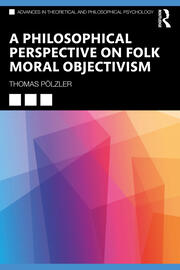
New York: Routledge. 2022. 236 pages.
Series: Advances in Theoretical and Philosophical Psychology
Philosophers have long debated whether morality is objective. But how do lay people think about this matter? A Philosophical Perspective on Folk Moral Objectivism discusses the philosophical aspects of this question in an accessible, integrated and coherent way.
The first part argues that many empirical studies have been unsuccessful in fully or exclusively measuring beliefs about moral objectivity. Still, there are a few lessons that can be drawn from them. Most importantly, lay people are not objectivists. They believe that moral statements only express desires or that their truth is relative to individuals or cultures. The book’s second part considers ways in which these empirical findings may help assess philosophical theories about moral objectivity. Overall, findings about people’s moral objectivity beliefs suggest that morality is not objective. The truth of the matter may even lie beyond the traditional objectivism/non-objectivism dichotomy.
This book develops a unique perspective on a thriving new area of research. It is a valuable resource for upper level undergraduates, postgraduates and researchers in moral psychology, theoretical psychology, experimental philosophy, metaethics and philosophy of the mind.
Reviewed by:
Joel Marks in Philosophical Quarterly, forthcoming
Moral Reality and the Empirical Sciences
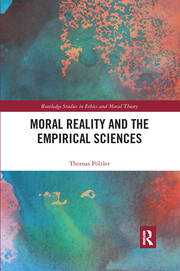
New York: Routledge. 2018. 248 pages.
Series: Routledge Studies in Ethics and Moral Theory
Are there objective moral truths (things that are morally right or wrong independently of what anybody thinks about them)? To answer this question more and more scholars have recently begun to appeal to evidence from scientific disciplines such as psychology, neuroscience, biology, and anthropology. This book investigates this novel scientific approach in a comprehensive, empirically focused, partly clarificatory, and partly metatheoretical way. It argues for two main theses. First, it is possible for the empirical sciences to contribute to the moral realism/anti-realism debate. And second, most appeals to science that have so far been proposed are insufficiently empirically substantiated.
The book’s main chapters address four prominent science-based arguments for or against the existence of objective moral truths: the presumptive argument, the argument from moral disagreement, the sentimentalist argument, and the evolutionary debunking argument. For each of these arguments I first identify the sense in which its underlying empirical hypothesis would have to be true in order for the argument to work. Then I show that the available scientific evidence fails to support this hypothesis. Finally, I also make suggestions as to how to test the hypothesis more validly in future scientific research.
Moral Reality and the Empirical Sciences is an important contribution to the moral realism/anti-realism debate that will appeal both to philosophers and scientists interested in moral psychology and metaethics.
Reviewed by:
Jason R. Raibley in Notre Dame Philosophical Reviews 2020.01.18
Aaron P. Elliott in Ethics 129 (4), 731-736
Razvan Sofroni in Grazer Philosophische Studien 96 (4), 646-654
Joel Marks in Ethical Perspectives 25 (3), 569-571
Michael Klenk in International Journal for the Study of Skepticism 10, 78-86
Antonio Gaitán Torres in Journal of Moral Philosophy 18 (5), 558-561